
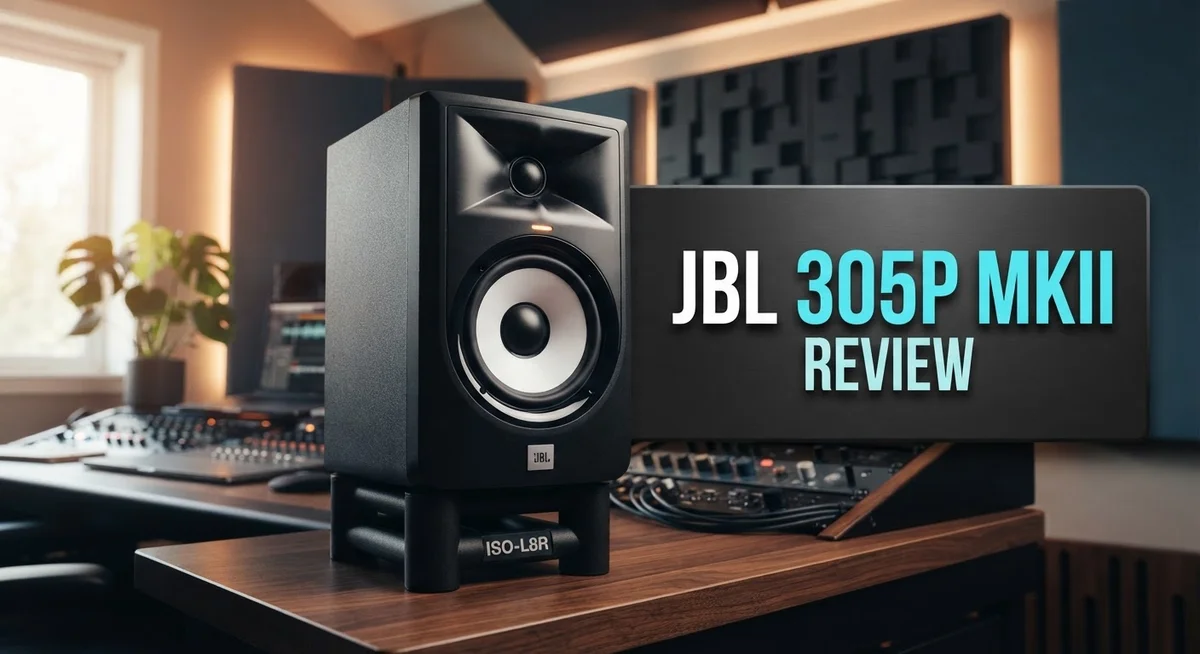
JBL 305P MkII Review: Studio Monitor Performance and Sound Quality
Looking for a studio monitor that sounds honest? The JBL 305P MkII delivers flat, detailed sound for serious mixing work.
This 2-way powered monitor packs a 5 inch midwoofer and a 1 inch dome tweeter. Two Class D amplifiers push 41W to each driver.
Sound engineers love its wide sweet spot. You get consistent imaging even if you shift positions in your room.
The Image Control Waveguide technology shapes sound waves for clear, accurate playback. This helps you hear every detail in your mix.
Yes, the 5″ driver limits deep bass extension. But the punchy midrange and treble make this monitor a solid pick for home studios.
We tested the JBL 305P MkII to see if it truly earns its reputation. This review covers everything you need to know before you buy.
In a Nutshell
Here is the quick rundown of the JBL 305P MkII for anyone short on time.
-
Power and punch: Two Class D amplifiers push 41W to each driver. This gives the monitor a punchy low end for its size.
-
Connection options: You get both balanced XLR and 1/4″ TRS inputs. This makes the monitor flexible for different studio setups.
-
The trade off: Class D amps can add higher THD than other amp types. Some listeners notice a slightly rumbly character in the bass.
-
Compact but limited: The small cabinet keeps desk space free. It also means the soundstage stays narrower than larger monitors.
-
Where it stands: Compared to rivals like the M-Audio AV30, the 305P MkII holds its own in detail and clarity.
-
Bottom line: This monitor suits home studios and bedroom producers who want accurate sound without huge speakers. It is not built for filling large rooms or handling heavy bass work.
Sound Quality and Frequency Response
The JBL 305P MkII shines when it comes to accurate frequency response. These monitors produce a remarkably flat output across the audio spectrum, which means what you record is what you get.
The 5 inch midwoofer handles frequencies from roughly 43Hz up to 3kHz. This driver excels at reproducing vocals, guitars, and drums with genuine clarity. You hear every detail without artificial coloration or boost.
The 1 inch dome tweeter takes over from 3kHz and climbs higher. Cymbals snap, sibilants sit naturally, and high frequency details emerge without harshness. This two way design creates a smooth handoff between drivers.
Real world listening reveals some nuances. The bass response feels punchy and present, but it doesn’t dig deep into sub bass frequencies. If your mix contains 30Hz content, you’ll struggle to hear it accurately on these speakers. Many producers compensate by using headphones for final bass checks or adding a subwoofer to their setup.
The Image Control Waveguide technology plays a key role here. This acoustic design controls how sound waves disperse into your room. You get a wide sweet spot, meaning the frequency response stays consistent even when you move slightly off axis. This matters because studio work often involves head movement during long sessions.
Class D amplifiers power both drivers with 41W each. These efficient amps keep heat low and noise minimal. However, they do introduce slightly higher total harmonic distortion compared to other amp types. In practice, this doesn’t muddy the sound noticeably at typical mixing volumes.
The overall frequency response feels honest and uncolored. You won’t hear exaggerated bass bumps or treble peaks. This neutrality makes the 305P MkII excellent for critical listening and mixing tasks where accuracy matters most.
Comparing frequency response to competitors like the M Audio AV30, the JBL holds ground with similar flatness and detail retrieval. The real strength emerges in how consistently these monitors maintain their character across different room positions and listening angles.

- PACKAGE INCLUDES: (2) 305P MkII 5 2-Way Powered Studio Reference Monitor Monitoring Speaker
- CRYSTAL-CLEAR IMAGING: 305P MkII’s patented Image Control Waveguide delivers precise, immersive sound with a...
- POWERFUL, REFINED AUDIO: Dual 41-Watt Class-D amplifiers in the 305P MkII ensure dynamic range and deep bass...
Last update on 2026-11-09 / Affiliate links / Images from Amazon Product Advertising API
Design, Build Quality, and Connectivity
The JBL 305P MkII features a compact cabinet design that fits snugly on studio desks without consuming excessive space. The speaker measures approximately 7.1 inches wide, making it practical for tight production setups. The black finish with a curved front baffle gives it a professional appearance that blends into most studio environments.
Build quality reflects solid construction throughout. The cabinet uses medium density fiberboard wrapped in a durable vinyl coating. The front baffle houses the 5 inch midwoofer and 1 inch tweeter in a sealed enclosure. Internal bracing keeps cabinet resonance minimal, which helps preserve the flat response these monitors deliver.
The connectivity options make integration straightforward. You’ll find balanced XLR inputs on the rear panel, which is the studio standard for professional audio work. A 1/4 inch TRS input provides an alternative for gear that uses quarter inch connectors. Both input types connect to the internal Class D amplifiers through the same signal path, so your choice depends on what cables your existing equipment uses.
The cooling design keeps the amplifiers at safe operating temperatures during extended sessions. Passive vents on the rear panel allow air circulation without adding noise. The speaker remains cool even during hours of continuous monitoring at moderate levels.
Weight distribution feels balanced when mounting on stands or desktop isolators. The 305P MkII won’t tip easily, and its compact footprint means isolation pads work effectively underneath. The rear panel includes a recessed power switch and LED indicator that shows when the speaker is active.
Durability appears solid for regular studio use. The vinyl coating resists dust accumulation better than bare MDF would. The tweeter dome sits protected behind the waveguide, reducing accidental contact damage. Long term reliability depends on avoiding moisture exposure and keeping dust filters clear around the rear vents.
Overall, the physical design prioritizes function over flash. Everything about the 305P MkII says “working monitor” rather than decorative piece. The construction quality justifies its place in professional studios where accuracy and reliability matter most.
Power Output and Amplification
The JBL 305P MkII uses two Class D amplifiers to deliver power where it counts. Each amplifier pushes 41W of output directly to its driver. This setup gives you enough muscle for studio monitoring without overwhelming a small room.
Class D amplification works differently than traditional designs. These amplifiers are highly efficient. They convert power quickly and waste less energy as heat. The tradeoff is that Class D amps can introduce higher THD (Total Harmonic Distortion) compared to other amp types. For studio work, this matters when you’re making critical mixing decisions.
The 41W per channel setup handles both the 5 inch midwoofer and the 1 inch tweeter independently. Your midwoofer gets dedicated amplification for lower frequencies. Your tweeter receives its own amplifier for detail in the highs. This separation means neither driver starves for power when you push the volume up.
Real world performance shows punchy bass response in the low mids. The midwoofer delivers energy from roughly 43Hz up to 3kHz without strain. You’ll notice impact on kick drums and bass lines. However, the internal DSP (Digital Signal Processing) does limit maximum output levels. This prevents clipping and protects the drivers during extended sessions.
The compact cabinet design works with this power output nicely. You don’t get a huge soundstage width, but the amplification stays clean within the speaker’s physical limits. Pushing these monitors hard reveals their constraints. They perform best when used at moderate to moderately high levels rather than extreme volumes.
Comparing to competitors like the M-Audio AV30, the JBL’s amplification approach offers similar efficiency. Both use Class D designs. Both deliver 41W per channel. The real difference comes down to how each speaker’s cabinet and DSP tune that power for your ears.
For bedroom producers and home studio owners, this amplification setup provides reliable, consistent monitoring. You get enough power for detailed work without needing massive speakers or external amplifiers taking up space.
Top 3 Alternatives
Yamaha HS5

- The installation version of the renown Yamaha HS5 Studio Monitor
- Includes mounting points and screws for installation
- Compatible with wall, ceiling, and baton brackets (sold separately)

Last update on 2026-11-09 / Affiliate links / Images from Amazon Product Advertising API
The Yamaha HS5 delivers accurate sound reproduction for music production and mixing. This speaker features a 1-inch tweeter and 5-inch woofer that work together to give you clear highs and solid lows. The front-facing ports reduce boundary issues when you place the speaker near walls or corners.
You get useful controls on the back panel. The high-frequency and low-frequency switches let you adjust the sound to match your room. The balanced XLR and RCA inputs give you flexibility with your audio equipment.
KRK Rokit 5

- Custom-designed Class D power amplifiers for better audio integrity and reduced operating temperature
- New 1” silk dome tweeter design for improved high-mid, high frequency, and phase performance
- Low Diffraction Baffle Design for lower distortion and better stereo imaging
Last update on 2026-11-09 / Affiliate links / Images from Amazon Product Advertising API
The KRK Rokit 5 brings professional-grade monitoring to your studio setup. This speaker uses a 5-inch woofer and 1-inch tweeter to produce detailed sound across the frequency range. The front-ported design helps you get consistent audio even in tight spaces.
Touch-sensitive controls sit on the top panel for easy adjustments. You can dial in the high and low frequencies to match your room’s acoustics. Multiple input options including XLR and RCA connections make it simple to integrate with your gear.
Presonus Eris E5

- An outstanding way to upgrade your monitoring so that your mixes translate.
- Now comes included with Studio One Prime and Studio Magic plug-in suite, over $1000 USD worth of music...
- 5.25-inch woven composite woofer delivers solid low-end sound with minimal bass distortion.
Last update on 2026-11-09 / Affiliate links / Images from Amazon Product Advertising API
The Presonus Eris E5 offers studio-quality sound in a compact form factor. It features a 5-inch woofer paired with a 1-inch silk dome tweeter. The speaker includes room correction tools that help you achieve balanced sound in various spaces.
The back panel gives you access to several helpful controls. You can adjust the high and low frequencies plus the input level to optimize performance. The XLR and RCA inputs ensure compatibility with most audio interfaces and equipment. The Eris E5 focuses on delivering honest, uncolored audio for accurate mixing decisions.
Imaging and Sweet Spot Performance
The JBL 305P MkII delivers impressive imaging performance that makes these monitors stand out in their category. The Image Control Waveguide technology creates a wider sweet spot than many competing models. You get accurate stereo imaging even when sitting slightly off center from your desk.
The sweet spot extends further than you might expect from such compact speakers. You can move left or right without losing detail or tonal balance. This flexibility matters when you’re working with a team or adjusting your seating position throughout a session.
The 1 inch dome tweeter maintains clarity across a broad listening area. High frequency details stay consistent whether you’re directly in front or positioned at an angle. The 5 inch midwoofer contributes to this wide imaging by handling midrange frequencies with precision and control.
Stereo separation feels clean and well defined. Panned instruments stay locked in their intended positions. You won’t experience the typical narrowing of the soundstage that happens with budget monitors when you move off axis.
The waveguide design plays a crucial role here. It controls how sound disperses into your room. This engineering choice prevents harsh reflections and keeps the listening experience smooth across multiple positions.
One thing to note: the soundstage width has some limitations compared to larger professional monitors. The compact cabinet size naturally constrains how wide the stereo image can expand. However, within realistic room sizes and seating distances, this rarely becomes a practical problem.
For bedroom producers and small studios, the imaging performance proves more than adequate. You get reliable stereo information for mixing and critical listening. The sweet spot remains forgiving enough that minor position changes won’t throw off your mixing decisions.
The combination of the waveguide technology and dual Class D amplifiers creates a focused, accurate presentation. You hear what’s actually in your recordings without exaggeration or collapse. This honesty in imaging makes the JBL 305P MkII a solid choice for anyone serious about accurate monitoring in a compact format.
Ideal Studio Applications and Use Cases
The JBL 305P MkII shines in several studio applications where its strengths directly support your work. Small home studios benefit most from these monitors because the compact footprint fits tight spaces without sacrificing accuracy.
Vocal recording and mixing ranks as a primary use case. The flat frequency response lets you hear exactly what you recorded. You catch problems early instead of discovering them later during mastering. The 1 inch dome tweeter reveals vocal sibilance and breath sounds clearly.
Podcast production works well with this setup. Spoken word content needs honest midrange representation, and the 5 inch midwoofer handles dialogue frequencies naturally. You’ll hear if your microphone technique needs adjustment or if room reflections are causing issues.
Electronic music production fits nicely here too. The punchy bass response in the low mids gives you confidence when working with synths and drum machines. You can make solid mixing decisions on beats and basslines, though you should verify your low end on headphones for frequencies below 60 Hz.
Acoustic instrument recording suits these monitors well. Guitars, pianos, and strings sound natural through the waveguide design. The wide sweet spot means you don’t need to sit in one exact spot to hear accurate balance.
Video editing and content creation benefit from the honest stereo imaging. Dialogue clarity stays consistent, and you’ll catch audio sync issues quickly. The balanced XLR and 1/4 inch TRS inputs connect directly to most audio interfaces without adapters.
Mastering work has limitations here. The 5 inch driver constraint means you should reference mixes on multiple systems before finalizing. These monitors work best as your primary mixing tool rather than your final verification step.
Educational settings work perfectly. Music students learn on accurate monitors without expensive gear. The compact size fits teaching studios and practice rooms easily.
One thing matters most: understand what these monitors do well. They excel at close field monitoring in small spaces. They provide honest feedback for most studio tasks. Use them as your primary mixing reference, but always verify critical decisions on headphones or other speaker systems before committing your final mix.
Pros and Cons
Pros
- Flat, detailed sound signature performs excellently for studio mixing and critical listening work
- Wide sweet spot and impressive stereo imaging make these monitors work well even when you’re not perfectly centered
- Compact cabinet size fits easily into small bedrooms, apartments, and home studios without taking up much space
- Punchy bass response in the low mids delivers surprising impact from the 5 inch driver
- Balanced XLR and 1/4 inch TRS inputs give you flexibility when connecting to different audio equipment
Cons
- Bass depth remains limited due to the 5 inch midwoofer, so you won’t get deep sub bass frequencies below 50Hz
- Class D amplification produces higher THD levels compared to traditional amplifier designs, which some listeners notice at high volumes
- Bass character can sound slightly rumbly rather than tight and controlled in certain rooms or with certain content
- Soundstage width feels narrower than larger professional studio monitors, which matters less for mixing but more for reference listening
Who Should Buy It
The JBL 305P MkII works best for specific types of users and projects. Let’s break down who gets the most value from these monitors.
Home studio producers fit perfectly here. You work in a bedroom or small apartment and need speakers that don’t demand much space. These monitors sit comfortably on a desk or shelf without dominating your room. The compact design means you can set up a serious mixing station almost anywhere.
Bedroom musicians and hobbyists will appreciate the honest stereo imaging. You don’t need to sit in an exact sweet spot to hear good separation between instruments. This flexibility matters when your studio space is tight or unconventional.
Podcast creators and voice over artists benefit from the flat, detailed sound signature. You can hear exactly how your vocals sound without coloration. The balanced XLR inputs connect easily to most recording interfaces. You’ll catch problems in your recordings that cheaper speakers might hide.
Electronic music producers gain a real advantage here. The punchy bass response in the low mids gives you solid feedback on your beats and synth work. You can make confident mixing decisions for club tracks and electronic productions.
Video editors and content creators should consider these speakers. The honest stereo imaging helps you catch audio problems before export. You’ll hear if dialogue sits evenly across both channels or if background music feels off center.
Students and educators find these monitors practical for audio classes. They teach proper mixing technique without excessive cost. Multiple pairs work well in a learning environment.
Important note: Skip these if you need deep bass response. The 5 inch driver won’t reproduce frequencies below 50Hz effectively. Professional mastering studios need larger monitors with better low end extension. If you mix hip hop or trap music that relies on sub bass frequencies, look elsewhere.
The sweet spot? Small to medium studios where space matters and your mixing needs stay focused on mid range clarity. These monitors deliver exactly what you need without unnecessary features or size.
Final Verdict
The JBL 305P MkII earns its reputation as a solid entry point for home studio work. Its flat sound profile and wide imaging make it a trustworthy tool for anyone serious about mixing.
Build quality feels sturdy for its size. The cabinet design and internal components suggest JBL put real engineering effort into this pair.
Compared to rivals like the M-Audio AV30, the 305P MkII holds its own in clarity and stereo imaging. Each brand has strengths, but JBL’s tuning leans more toward professional accuracy.
Class D amplifiers bring some tradeoffs. Higher THD levels mean you might notice subtle distortion at louder volumes. This won’t bother casual listeners, but critical ears might catch it during detailed mastering sessions.
The internal DSP also caps maximum output. You get plenty of volume for typical home studio use, but pushing these speakers to their limits reveals their ceiling.
Should you buy them? If you’re building a home studio and need honest, reliable monitoring, yes. These speakers deliver where it counts most: accurate frequency response and dependable imaging.
Skip them if you’re mastering bass heavy genres or need studio grade headroom for live sound applications. The 5 inch driver and DSP limitations show up quickly in those scenarios.
For everyone else, especially content creators, podcasters, and electronic music producers, the JBL 305P MkII checks the right boxes. It offers a genuine studio experience without unnecessary complications.
Think of these monitors as a stepping stone. They teach you what accurate sound actually sounds like, preparing you for bigger studio investments later.
Final take: The JBL 305P MkII isn’t perfect, but it’s honest. It tells you the truth about your mix, which is exactly what a studio monitor should do. For home producers and small studio owners, that honesty makes all the difference.
Frequently Asked Questions
Can I use the JBL 305P MkII for music production?
Yes, absolutely. These monitors deliver a flat, detailed sound signature that works well for music production. The 2-way design lets you hear what you’re actually recording without heavy coloring or bass boost. Home studio producers and electronic music creators find them particularly useful for mixing mid range focused tracks.
However, keep in mind the 5 inch driver limits bass depth. If you’re working with bass heavy genres like dubstep or trap, you’ll want to supplement with a subwoofer for the lowest frequencies.
What’s the difference between the JBL 305P MkII and the M-Audio AV30?
Both monitors sit in the same entry level category. The 305P MkII tends to offer better stereo imaging and a wider sweet spot, meaning you get good sound even when you’re not perfectly centered. The M-Audio AV30 has its own strengths, but the JBL holds its own in clarity.
Your choice depends on your room and personal preference. Try them both if possible before deciding.
Does this monitor work for podcasting and voice over work?
Yes, these are excellent for spoken word content. The flat frequency response means your voice recordings sound honest and uncolored. You’ll hear exactly what your microphone is capturing, which helps you catch recording problems early.
The compact size also fits nicely into small home studios where podcasters and voice actors often work.
Will I need a subwoofer with the JBL 305P MkII?
It depends on your work. For vocals, podcasts, and mid range focused music, no. The 5 inch driver handles these well.
For bass heavy music, video game sound design, or film work, a subwoofer adds significant value. You’ll capture low frequencies below 50Hz that these monitors can’t reproduce cleanly.

DK is a tech enthusiast and product reviewer dedicated to helping readers navigate the ever-evolving world of technology. With a passion for testing and comparing the latest gadgets, software, and AI tools, DK breaks down complex tech into simple, actionable insights for everyday users.


