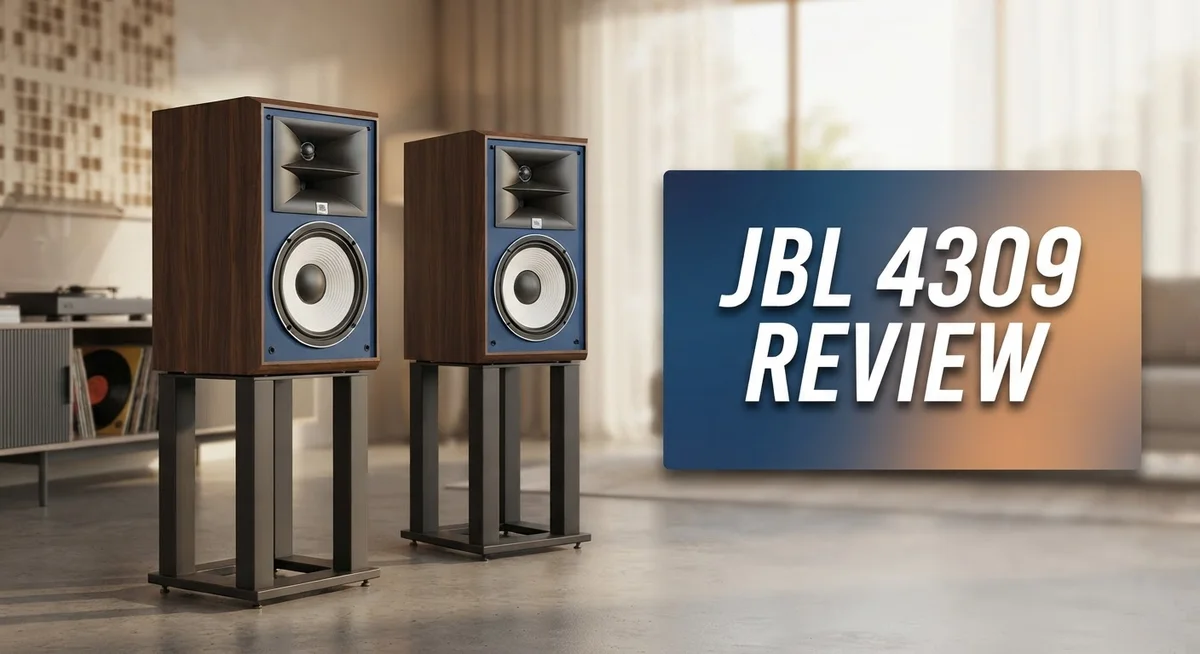
JBL 4309 Review: Premium Bookshelf Speaker Performance and Sound Quality
The JBL 4309 brings back classic bookshelf speaker style with modern technology. It carries JBL’s studio monitor heritage into a compact home speaker.
This speaker uses a 6.5 inch pure pulp cone woofer. It pairs with a 1 inch compression driver and HDI horn design.
That horn loaded tweeter sets the 4309 apart from many rivals. It gives the sound a distinct focus and clarity.
Build quality feels premium. The finish looks sharp and fits well in any living room setup.
Sound performance stays loud and full range. Soundstaging and imaging impress listeners who want detail and depth.
This review looks at what makes the JBL 4309 special. We cover specs, performance, strengths, and weaknesses.
By the end, you will know if this speaker fits your setup. Let’s explore what JBL built here.
In a Nutshell
Here is a quick summary before you scroll further.
-
The JBL 4309 delivers impressive soundstaging and sharp imaging focus. Instruments sound clear and well placed.
-
This speaker has a 4 ohm impedance. You need a compatible amplifier to get the best performance.
-
Bass extension stays limited. This speaker will not shake your room but it stays clean and controlled.
-
Sensitivity ranges between 85 and 87dB. It pairs well with mid powered amps without much strain.
-
The bass reflex design helps push air efficiently. This adds punch without needing a huge cabinet.
-
Compared to rivals like the Wharfedale Linton or Klipsch Heresy, the 4309 holds its own with a distinct horn loaded sound.
-
Overall, this speaker suits listeners who want detailed highs and a premium finish in a compact shell. It fits small to medium rooms nicely.
Design and Build Quality
The JBL 4309 wears its classic heritage with pride. This bookshelf speaker channels vintage aesthetics while embracing modern engineering standards. The cabinet construction uses solid materials that resist vibration and unwanted resonance during playback.
The front baffle features a carefully sculpted design. The 1 inch compression driver sits prominently above the 6.5 inch woofer. This vertical arrangement creates a natural listening experience when speakers sit at ear level on shelves or stands.
Finish options reflect premium attention to detail. The speaker comes in wood veneers that feel authentic to the touch. Each unit displays consistent stain quality across the cabinet surfaces. The grille cloth sits flush against the frame without gaps or loose edges.
The woofer cone uses pure pulp material. This choice matters because pulp absorbs vibrations better than synthetic alternatives. The result feels lighter and more responsive during fast musical passages. The cone surround remains flexible yet durable for years of reliable operation.
The HDI horn loading on the tweeter represents a significant design choice. Unlike conventional dome tweeters, this compression driver sits inside a specially shaped horn. The horn focuses sound waves forward while reducing diffraction effects. This approach delivers clearer dialogue and instrument separation compared to flat tweeter designs.
Binding posts accept both banana plugs and bare wire connections. The terminals sit recessed slightly into the rear panel. This protects connections from accidental contact during speaker placement or repositioning.
The bass reflex port opens on the rear panel. This design allows air movement to support low frequency output. However, rear placement means you cannot push these speakers flush against walls without losing bass response.
Weight distribution feels balanced for a bookshelf speaker. The cabinet sits stable on most stands without tipping concerns. The overall footprint remains compact enough for shelving units or desktop setups.
Build quality justifies the design philosophy. Every seam shows careful assembly. The speaker feels substantial when moved, suggesting internal bracing and quality materials throughout. This construction approach promises longevity and consistent sound performance over extended ownership periods.

- POWERED LOUDSPEAKER SYSTEM - The JBL 4305P Studio Monitor is a completely self-contained powered loudspeaker...
- A WORLD OF POSSIBILITIES - Patented JBL acoustic technologies render sound with incredible accuracy & powerful...
- WIRELESS STREAMING AUDIO - The integrated streaming engine provides both wired and wireless network audio...
Last update on 2026-10-26 / Affiliate links / Images from Amazon Product Advertising API
Sound Performance and Acoustics
The JBL 4309 excels in delivering clarity across the frequency spectrum. The horn-loaded tweeter produces crisp highs without harshness or fatigue during extended listening sessions. Midrange vocals sit forward and engaging, making speech and acoustic instruments feel natural in your room.
Bass response from the 6.5 inch woofer reaches down adequately for most music genres. The bass reflex design amplifies low-end efficiency, though deep sub-bass remains modest compared to larger floorstanding models. This character suits rock, jazz, and pop better than electronic music demanding extreme low-end punch.
The sensitivity rating of 85 to 87dB means these speakers play loud without straining. Your amplifier drives them comfortably, and they respond well to both solid-state and tube electronics. The 4 ohm impedance stays stable across frequencies, avoiding dips that stress amplifiers.
Soundstaging proves impressive for a bookshelf design. Instruments position themselves with precision across the stereo field. Depth staging extends beyond the speaker plane, creating an open, spacious presentation. Imaging focus remains tight, so you hear exactly where each sound originates.
The tweeter and woofer integrate seamlessly through the crossover network. No tonal coloration appears at the handoff point between drivers. This smooth transition keeps vocals and acoustic instruments sounding coherent and unified.
Dynamic punch arrives when recordings demand it. Drum attacks snap cleanly. Piano strikes feel weighted and authentic. The speakers handle transients without compression or bloat, revealing detail in complex passages.
Room placement affects performance noticeably. Position the 4309 away from walls to minimize bass boom. Angling the tweeters toward ear level improves imaging further. The compact size fits shelves, stands, or wall mounts without dominating your space.
Overall, the 4309 prioritizes accuracy and refinement over bass extension. Listeners seeking detailed, articulate sound in a stylish package find these speakers rewarding. The horn-loaded tweeter remains the standout feature, delivering character that conventional dome tweeters simply cannot match.
Horn-Loaded Tweeter Technology
The HDI horn loading system sets the JBL 4309 apart from standard bookshelf speakers. This compression driver design focuses sound waves with precision. The horn acts as an acoustic transformer that shapes the tweeter’s output.
Horn loading delivers several practical benefits. Sound disperses more uniformly across your listening room. You hear consistent treble whether you sit directly in front or off to the side. This matters because conventional dome tweeters narrow their coverage at high frequencies.
The 1 inch compression driver works within the horn cavity. Air pressure builds inside the horn, which increases efficiency. The tweeter produces more output with less electrical power required. This design choice explains why the 4309 maintains clarity even at lower volumes.
Integration with the woofer happens through careful crossover design. The horn tweeter and 6.5 inch pulp cone woofer blend seamlessly. Midrange frequencies transition smoothly between drivers. You won’t hear any disconnect or tonal shift in the crossover region.
The horn’s curved shape matters. JBL engineered the HDI horn to minimize diffraction. Diffraction occurs when sound waves bend around speaker edges. By shaping the horn properly, unwanted reflections decrease. The result is cleaner treble response with fewer colorations.
This technology influences how the 4309 handles dynamic passages. When music demands sudden peaks, the horn tweeter responds instantly. Transient attacks sound crisp and defined. Cymbals shimmer without harshness. Vocals maintain natural presence without sounding artificial.
Room acoustics interact differently with horn-loaded designs. Hard reflective surfaces affect the sound less negatively than with dome tweeters. Your listening room’s characteristics become less critical to final sound quality.
The horn loading also affects impedance characteristics. The 4 ohm rating remains stable across the frequency range. Amplifiers deliver consistent power delivery. This stability matters for both tube and solid state amplifiers.
The HDI horn represents JBL’s professional audio heritage. Studio monitors and cinema speakers use similar technology. The 4309 brings this proven approach to home listening. You get precision-engineered tweeter performance in a compact bookshelf format. This distinctive feature justifies the speaker’s reputation among audiophiles seeking detailed, refined sound.
Top 3 Alternatives
Klipsch The Fives

- TRUE ENTERTAINMENT: Easy-to-use, powered, high-def speakers
- TRUE HI-FI: Powerful, high-fidelity sound from dedicated right and left speakers
- TRUE CONNECTIVITY: These speakers feature a variety of wireless and wired connection options for your movies...
Last update on 2026-11-09 / Affiliate links / Images from Amazon Product Advertising API
Klipsch The Fives deliver a compact speaker solution for serious listeners. These speakers feature a horn-loaded tweeter that produces crisp, detailed highs. The design emphasizes clarity and presence without taking up much space on your desk or shelf.
The cabinet construction keeps distortion low. You get a warm midrange that works well for music and movies. Connection options include RCA, USB, and Bluetooth for flexibility. Many users appreciate the retro aesthetic combined with modern performance.
KEF LS50 Meta

- EXCEPTIONAL PASSIVE HIGH-FIDELITY: Upgrade your home theater or two-channel audio system with these premium...
- METAMATERIAL ABSORPTION TECHNOLOGY (MAT): KEF's groundbreaking MAT technology eliminates 99% of high-frequency...
- REVOLUTIONARY UNI-Q DRIVER: The 12th-generation Uni-Q driver array disperses sound evenly, creating a massive...

Last update on 2026-11-09 / Affiliate links / Images from Amazon Product Advertising API
KEF LS50 Meta speakers represent a refined approach to compact audio. The Uni-Q driver technology positions the tweeter inside the woofer for excellent imaging and soundstage. This design choice creates a listening experience that feels open and three-dimensional.
These speakers excel at revealing fine details in recordings. The cabinet uses special materials to reduce resonance and coloration. They work beautifully for critical listening, whether you’re evaluating music or enjoying your favorite albums. Setup flexibility comes from multiple input options and adjustable controls.
Yamaha HS8

- The information below is per-pack only
- 8 inch cone woofer and 1 inch dome tweeter; Produce low distortion sound with a well-defined bottom end at any...
- 38Hz to 30kHz frequency response; Power consumption: 60 watts
Last update on 2026-11-09 / Affiliate links / Images from Amazon Product Advertising API
Yamaha HS8 monitors bring professional-grade accuracy to your listening space. These speakers use a flat frequency response that lets you hear recordings exactly as engineers intended. The larger woofer size handles low frequencies with authority and control.
The cabinet design minimizes standing wave issues common in small rooms. You’ll notice precise stereo imaging and accurate sound reproduction across the frequency spectrum. These monitors suit both critical listening and production work. The professional heritage means you get reliable performance night after night.
Power Handling and Amplifier Compatibility
The JBL 4309 delivers excellent power handling capabilities that make it suitable for various amplifier types and listening scenarios. These speakers maintain stability across a wide range of input levels without distortion or strain.
The 4 ohm impedance is the critical factor you need to understand. Most modern amplifiers handle this impedance without issues, but older tube amps or certain integrated amplifiers may struggle. You should verify your amplifier’s specifications before connecting the 4309s. Check if your amp can drive 4 ohm loads safely.
Solid state amplifiers typically work best with the 4309. They handle the lower impedance efficiently and deliver clean power across the frequency range. Class D amplifiers also pair well with these speakers. The 4309 does not demand extreme wattage to perform admirably.
The sensitivity rating of 85 to 87dB means these speakers reach satisfying volume levels with moderate amplifier power. You don’t need a high-powered amp to enjoy them fully. Even 30 to 50 watts per channel produces excellent results in typical rooms. Higher wattage amplifiers offer additional headroom for dynamic peaks, but remain optional rather than essential.
The horn loaded tweeter influences amplifier compatibility in subtle ways. Horn designs naturally exhibit different impedance curves compared to conventional tweeters. This characteristic means the 4309 presents a more consistent load to your amplifier across the frequency spectrum.
Tube amplifiers require careful consideration. Lower impedance loads stress tube output transformers more than 8 ohm speakers do. If you own vintage tube gear, verify that it supports 4 ohm operation. Some tube amps simply cannot handle this impedance safely.
The bass reflex design also affects power handling characteristics. The rear port interacts with room acoustics and amplifier damping factor. Better amplifiers with higher damping factors provide tighter bass control. This relationship becomes more noticeable in smaller listening rooms.
For best results, pair the 4309 with amplifiers rated between 30 and 200 watts per channel. Quality matters more than raw power here. A well designed 50 watt amp outperforms a mediocre 150 watt model. Match your amplifier’s output impedance specifications to the 4 ohm rating, and these speakers will reward you with reliable, dynamic performance.
Soundstaging and Imaging Capabilities
The JBL 4309 creates a soundstage that extends well beyond its compact bookshelf frame. This spatial performance comes from the horn loaded tweeter design, which projects sound with precision and clarity throughout your listening room.
Imaging precision stands out as a key strength of these speakers. The 1 inch compression driver pinpoints vocals and instruments with remarkable accuracy. You hear exactly where each sound originates in the stereo field. The tweeter’s horn cavity focuses high frequencies in a controlled pattern, preventing the harsh reflections you get from conventional dome tweeters.
The crossover network integrates the 6.5 inch woofer and tweeter seamlessly. This integration means no frequency gaps appear between the drivers. Instruments transition smoothly across the frequency range without losing definition or presence.
Room placement significantly impacts soundstage depth and width on the 4309. Position these speakers away from corners and side walls for optimal results. The horn loading responds differently to room acoustics compared to standard bookshelf designs. You’ll notice improved clarity when you give them proper breathing room.
Dynamic passages reveal the imaging benefits most clearly. When orchestral recordings demand precision, the 4309 delivers. Cymbals shimmer with realistic decay. Snare drums snap into focus. Bass drums anchor the low end without muddying the midrange clarity.
The sensitivity rating of 85 to 87dB allows these speakers to achieve impressive soundstaging without requiring excessive amplifier power. This efficiency means your amplifier’s dynamic headroom stays available for those demanding moments when recordings call for sudden volume swings.
Horn loaded designs naturally excel at maintaining consistent imaging angles across different listening positions. This means your friend sitting off to the side hears a similarly well defined soundstage as you do sitting in the sweet spot. The technology prevents the narrow sweet spot that plagues many conventional bookshelf speakers.
The 4309’s soundstaging and imaging capabilities make these speakers particularly rewarding for jazz, classical, and acoustic music lovers. Vocals sit forward with presence while instruments occupy their own space in the soundfield. This clarity and separation justify the attention JBL paid to the horn loading system and crossover design.
Pros and Cons
Pros
- Horn loaded tweeter delivers clarity and precision that stands apart from conventional bookshelf speakers
- Excellent power handling works reliably with solid state amplifiers and various amplifier types
- Full range playback reaches satisfying volume levels with moderate amplifier power thanks to 85 to 87dB sensitivity
- Premium build quality and finish reflect JBL’s professional audio heritage
- Compact frame produces soundstage that extends well beyond its bookshelf size
Cons
- Limited bass extension means you may need a subwoofer for deep low frequency content
- 4 ohm impedance requires compatible amplifiers, which narrows your amplifier choices
- Tube amplifiers need careful consideration due to impedance characteristics
Who Should Buy It
The JBL 4309 works best for listeners who already own compatible amplifiers. You need solid state amps or carefully matched tube equipment to get the most from these speakers. If your current amplifier can handle 4 ohm loads, you’re ready to go.
Music enthusiasts who value clarity should consider the 4309 seriously. The horn loaded tweeter delivers precise sound that stays consistent across your listening room. You’ll hear every detail in vocals and instruments without harshness or fatigue.
These speakers suit people with smaller to medium sized rooms. The compact bookshelf design fits living rooms, home offices, and studios without taking up much space. The soundstage extends far beyond what the physical size suggests.
If you want full range playback without a subwoofer, look elsewhere. The 4309 has limited bass extension. You’ll need a separate subwoofer for deep bass content like movie soundtracks or electronic music. However, if you mostly listen to jazz, classical, or vocals, the bass limitation matters less.
Professional audio engineers appreciate the 4309 because of its heritage. JBL’s background in studio equipment shows in the build quality and finish. If you work with music production or critical listening, these speakers perform reliably.
Casual listeners who want plug and play simplicity should explore other options. The 4309 demands some knowledge about amplifier compatibility and room setup. You benefit from understanding how to position them correctly and match them with the right gear.
Home theater fans have mixed results with the 4309. They excel at music playback and dialogue clarity. However, the limited bass extension makes action movies less impactful without a dedicated subwoofer.
Listeners in treated or acoustically aware spaces get the best performance. The 4309 responds well to proper room treatment and careful placement. If you’ve invested in your listening environment, these speakers reward that effort.
Finally, the 4309 appeals to people who prioritize soundstaging and imaging over raw power. The horn design creates a three dimensional listening experience that impresses most who hear it properly set up.
Final Verdict
The JBL 4309 stands out as a serious choice for music lovers who want detailed sound. It brings studio grade engineering into a compact cabinet. This makes it a strong pick for dedicated listening rooms.
Sound quality here feels precise and controlled. The speaker rewards careful listening more than casual background music. You get a clear window into your favorite recordings.
If you already own a good amplifier, this speaker rewards that investment. Pair it with the right gear, and it performs at a high level. Skip it if you want a simple all in one setup.
Compared to rivals like the Wharfedale Linton or Klipsch Heresy, the JBL 4309 leans more toward tight imaging than raw bass punch. Each speaker in this class has its own personality. Your room and your ears will decide the winner.
Think about your listening habits before buying. Do you sit close to your speakers and focus on details? Then this speaker fits you well.
Do you want speakers that fill a large room with deep bass alone? Then look at other models in the JBL lineup, like the 708P. The 4309 shines in smaller, focused setups.
We think the JBL 4309 earns its spot among top bookshelf speakers today. It blends classic JBL design with modern horn loaded technology. That mix is hard to find elsewhere.
Buyers who care about craftsmanship will appreciate the fit and finish. This speaker feels built to last for years of listening. It rewards patience and thoughtful setup.
In short, the JBL 4309 is not for everyone. But for the right listener, it delivers something special. Its blend of clarity, imaging, and build quality make it a smart long term choice.
If you value precision over pure volume, this speaker deserves a spot on your shortlist. Give it a proper amplifier and a treated room, and it will reward you every time you press play.
Frequently Asked Questions
Do the JBL 4309 speakers work with any amplifier?
No, they require a compatible amplifier. The 4 ohm impedance means your amp must handle low impedance loads. Most modern amplifiers support 4 ohm speakers, but some older or budget models do not. Check your amplifier’s specifications before purchasing. If you already own a quality amplifier rated for 4 ohms, you’re ready to go.
Can I use the JBL 4309 without a subwoofer?
Yes, you can use them alone. The 6.5 inch woofer delivers full range playback at satisfying volume levels. However, bass extension remains limited. Deep low frequencies will not reach the same impact as larger speaker systems. If you listen to bass heavy music or watch action films, adding a subwoofer enhances the experience significantly.
How do the JBL 4309 compare to the Wharfedale Linton or Klipsch Heresy?
The JBL 4309 leans toward tight imaging and precise soundstaging. The horn loaded tweeter creates a focused listening experience. Wharfedale Linton speakers offer a warmer character, while Klipsch Heresy models emphasize efficiency and dynamic output. Your choice depends on whether you prefer detailed clarity or a more relaxed, spacious sound. All three excel in different ways for music lovers.
What room size works best for these speakers?
The JBL 4309 performs best in smaller to medium sized rooms. The compact frame produces a soundstage that extends well beyond its bookshelf size. Treated or acoustically aware spaces get the best results. Large rooms may feel undersized without additional speakers or subwoofer support. Consider your listening space before deciding.

DK is a tech enthusiast and product reviewer dedicated to helping readers navigate the ever-evolving world of technology. With a passion for testing and comparing the latest gadgets, software, and AI tools, DK breaks down complex tech into simple, actionable insights for everyday users.