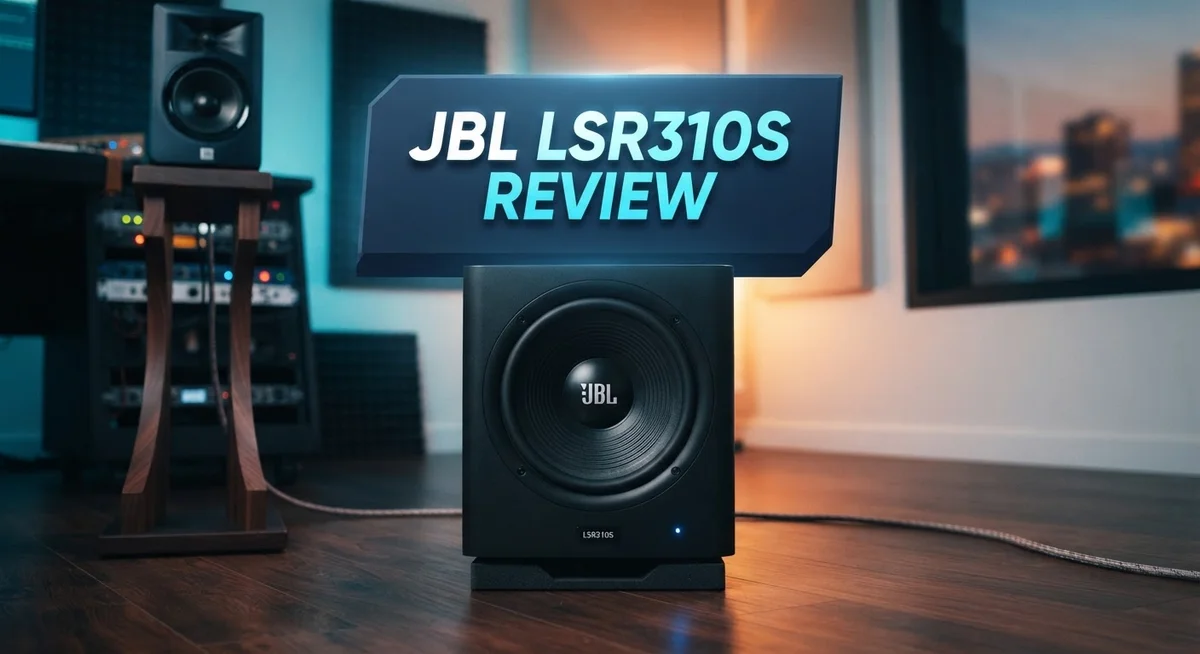
JBL LSR310S Review: Professional Studio Subwoofer for Audio Production
Are you tired of weak bass in your studio setup? The JBL LSR310S might be the answer you need. This subwoofer brings deep, clean low end to any mixing room.
It packs a 10 inch down firing driver with a 200W amplifier. That combo pushes frequency response down to 20 Hz. Your mixes will feel the difference instantly.
This review breaks down what makes the LSR310S stand out. We look at its build quality, sound performance, and unique features like the Slip Stream Port.
We also compare it to rivals like the Kali Audio WS-6.2 and Yamaha HS8S. By the end, you will know if this subwoofer fits your studio needs.
Let’s dive into what this powerful subwoofer really offers.
In a Nutshell
-
The JBL LSR310S pushes bass down to 20 Hz, giving your studio a full low end.
-
Its Slip Stream Port design keeps airflow smooth and reduces port noise during heavy bass hits.
-
The XLF extended low frequency setting adds extra punch when a track needs more depth.
-
You get a peak output of 113 dB, which is plenty for loud mixing or mastering sessions.
-
Connectivity is flexible with both XLR and 1/4 inch balanced inputs, so it fits most setups.
-
The build feels professional and looks sleek in any room, though its large footprint may need extra space.
-
A few reviewers mention mixed feedback on tone, so personal taste can vary here.
-
Against rivals like the Kali Audio WS-6.2 and Mackie MK3, the LSR310S still holds strong in power and dynamic feel.
Key Specifications and Features
The JBL LSR310S delivers impressive technical specifications that matter for serious studio work. Its 10 inch down firing driver sits at the heart of this subwoofer’s performance, engineered to handle demanding low frequency work without distortion.
The frequency response reaches down to 20 Hz, which covers the entire spectrum most music and film projects need. This means you capture sub bass frequencies that smaller subs simply cannot reproduce. The 200W amplifier provides enough power to move air in medium to large rooms without strain.
Peak output hits 113 dB, giving you serious headroom during intense mixing or mastering sessions. You can push this sub hard without it running out of steam or sounding compressed. The Slip Stream Port technology plays a crucial role here. It keeps airflow smooth and reduces unwanted port noise, so you hear clean bass instead of turbulence artifacts.
The XLF extended low frequency setting is a game changer for certain content. When your mix needs extra depth or you’re working on film sound design, this mode adds noticeable punch below the normal crossover point. It’s not always needed, but having the option makes this sub more versatile.
Connectivity options keep things simple and practical. Both XLR and 1/4 inch balanced inputs mean you can connect this sub to virtually any audio interface, mixer, or monitor controller. No adapter frustration.
The selectable crossover feature lets you integrate the LSR310S smoothly with your main monitors. You control where the sub takes over from your full range speakers, ensuring a seamless handoff with no dead zones or overlap issues.
Build quality feels solid throughout. The cabinet uses professional grade materials, and everything is designed to last through years of studio use. The sleek appearance fits modern control rooms without looking out of place.
These specifications combine to create a subwoofer that handles professional work reliably. Whether you’re mixing hip hop, electronic music, or film scores, the LSR310S gives you the tools to hear what’s actually in your low end.

- This patented JBL port design works in concert with the LSR310S low frequency driver for deep, dynamic bass...
- A JBL first, the XLF setting activates a specially-engineered tuning that emulates the ample bass tuning used...
- The custom-designed driver in the LSR310S exemplifies JBL engineering prowess, delivering deep low frequency...
Last update on 2026-11-09 / Affiliate links / Images from Amazon Product Advertising API
Design and Build Quality
The JBL LSR310S shows solid construction throughout its chassis. The cabinet uses rigid materials that resist vibration and unwanted resonance during playback. This matters because a sturdy build keeps bass clean and prevents the subwoofer from adding noise to your mix.
The down firing 10 inch driver sits inside a well braced enclosure. This design choice helps isolate the driver from external vibrations. You’ll notice the speaker feels heavy and substantial when you set it up, which signals good engineering.
The front panel keeps controls simple and accessible. You get straightforward adjustment knobs for level and crossover settings. The layout makes it easy to dial in your preferred bass response without confusion.
Cooling vents are positioned strategically around the cabinet. The 200W amplifier generates heat during long mixing sessions, so proper ventilation matters. JBL designed these openings to maintain consistent performance over time.
The Slip Stream Port technology deserves special mention here. Unlike traditional ports that can sound boxy or create air noise, this design keeps airflow smooth and controlled. You hear cleaner bass transients as a result.
Input connectors sit on the rear panel in a practical arrangement. Both XLR and 1/4 inch balanced inputs use quality connectors that feel reliable. The cable routing stays organized and doesn’t interfere with the cabinet’s appearance.
The footprint is admittedly large, so placement requires planning. The subwoofer measures significantly in width and depth. Make sure your studio space can accommodate this before purchasing.
Finish options keep the aesthetic professional and neutral. The cabinet color blends into most studio environments without standing out awkwardly. The sleek appearance complements modern and traditional control rooms alike.
The overall construction reflects professional studio equipment standards. JBL built this subwoofer to handle daily use in demanding environments. You can rely on this speaker for years of consistent performance without worrying about durability issues.
Bass Performance and Sound Quality
The JBL LSR310S proves itself as a serious contender for studio work that demands deep, controlled bass. The 10 inch down firing driver pushes air with authority, and that 200W amplifier gives it real muscle to move air without strain.
What makes the bass stand out is how clean it stays even at high volumes. Many subwoofers muddy the low end or create boomy peaks. This one maintains clarity from 20 Hz all the way up. You hear every note, every kick drum detail, and every bass line texture without distortion creeping in.
The Slip Stream Port design keeps airflow smooth and reduces port noise during heavy bass hits. This means you get punch without that annoying rushing air sound some subs produce. The XLF extended low frequency setting adds extra punch when a track needs more depth. Flip this on for film scoring or electronic music that demands serious low end impact.
Peak output reaches 113 dB, which is plenty for loud mixing or mastering sessions. This headroom matters when you need to hear how your mix behaves at different volumes. You can push the LSR310S hard without it breaking down or losing detail.
The selectable crossover feature lets you integrate the LSR310S smoothly with your main monitors. This flexibility means you can dial in exactly where the sub takes over from your mains. Different rooms and different speaker setups all work with this design.
Some reviewers mention mixed feedback on overall tone, which suggests personal taste plays a role here. What sounds perfect for one mixing style might feel different for another. This is normal with subwoofers since room acoustics change everything.
The dynamic performance shines during fast material. Kick drums punch hard. Bass synths stay tight. The driver responds quickly to transients instead of lagging behind the music. This responsiveness makes mixing feel more natural and immediate.
For serious studio work, the LSR310S delivers the bass performance you need to make confident mixing decisions.
Top 3 Alternatives
Yamaha HS8

- The information below is per-pack only
- 8 inch cone woofer and 1 inch dome tweeter; Produce low distortion sound with a well-defined bottom end at any...
- 38Hz to 30kHz frequency response; Power consumption: 60 watts

Last update on 2026-11-09 / Affiliate links / Images from Amazon Product Advertising API
The Yamaha HS8 brings professional studio sound to your workspace. This monitor delivers accurate bass response and clear midrange detail. You get a 8-inch woofer paired with a 1-inch tweeter, which means tight low-end performance without muddiness.
The HS8 includes a dedicated bass port on the back. This feature lets you adjust how much low-frequency energy enters your room. You can place it against a wall or in open space—the monitor adapts well to different setups.
KRK Rokit 8

- Textile dome tweeter for pristine highs
- Lightweight, woven glass fiber composite woofer delivers clear midrange and tight bass
- 8” Glass Aramid Woofer with 1" Textile Dome Tweeter
Last update on 2026-11-09 / Affiliate links / Images from Amazon Product Advertising API
KRK’s Rokit 8 offers powerful monitoring with a unique woofer design. The Kevlar cone material provides consistent sound across different frequencies. You’ll notice clean vocals and punchy drums with this setup.
This monitor features front-firing ports, which means you can position it closer to walls without losing clarity. The Rokit 8 includes a volume knob and multiple input options. You get flexibility in how you connect your audio equipment to the system.
Adam Audio T8V

- Louder and Lower - The T8V is designed around the same technology, features and build quality as its smaller...
- Extend your low end — With its best-in-class bass extension that reaches 33 Hz, the T8V is perfect for...
- Whether creating bass-intense music like EDM, hip hop or scoring film or: The T8V with its industry-leading...
Last update on 2026-11-09 / Affiliate links / Images from Amazon Product Advertising API
Adam Audio’s T8V stands out with its ribbon tweeter technology. This design produces smooth, detailed highs that reveal every layer of your mix. The 8-inch woofer handles bass duties with precision and control.
The T8V includes a 3-position HPS (High-Frequency Protection System) switch. This tool lets you adjust the top-end response based on your room’s acoustics. You can also control the bass output with a dedicated switch. The monitor’s compact footprint fits nicely on studio desks without taking up excessive space.
Connectivity and Integration
The JBL LSR310S connects to your studio setup through balanced XLR and 1/4″ inputs on the rear panel. Both connectors use professional grade construction, so you get reliable signal transmission without noise issues.
The balanced connections matter because they reject electrical interference. Your audio stays clean even when cables run long distances across a studio. This is especially important if you’re mixing in larger rooms or complex setups.
Integration with your main monitors happens through the selectable crossover feature. You can adjust where the LSR310S takes over from your primary speakers. This flexibility lets you match the subwoofer to your existing monitoring system without fighting frequency overlap.
The XLF extended low frequency setting gives you another control option. You can boost or reduce the low end response depending on your room and mixing needs. This practical adjustment means the subwoofer adapts to different studio environments instead of forcing you to adapt to it.
Placement considerations affect connectivity indirectly. The rear panel inputs sit in an accessible location, so running cables stays straightforward. However, the large footprint means you’ll need to plan where the unit goes before wiring everything up. Some studios might struggle with corner placement or tight spaces.
The down firing 10 inch driver creates a specific acoustic interaction with your room. Bass waves bounce off the floor, which can either help or hurt depending on your floor type and room dimensions. Hard floors couple energy differently than carpeted spaces, so integration varies by location.
The 200W amplifier powers everything internally. You don’t need external amplification or additional gear to get the subwoofer working. This self contained design simplifies your signal chain and reduces cable clutter.
Cooling vents positioned around the cabinet allow proper airflow. This matters during long mixing sessions when the amplifier generates heat. Proper ventilation keeps the subwoofer performing consistently throughout your work day without thermal issues affecting sound quality or equipment lifespan.
Room Placement and Calibration
The JBL LSR310S needs careful thought when you place it in your studio. The down firing 10 inch driver works best when the subwoofer sits on a solid floor. Hard surfaces like concrete or wood perform better than carpet because they let bass frequencies travel freely through your room.
Distance from walls matters significantly. Position the LSR310S at least 1 to 2 feet away from rear walls and corners. This spacing prevents bass buildup that can muddy your mix. Corner placement amplifies low frequencies and creates acoustic problems you’ll hear immediately when you mix on other systems.
Isolation is your next step. Bass frequencies travel through vibrations in your floor. Placing the subwoofer on isolation pads or stands decouples it from your room structure. This simple addition reduces vibrations that travel into your mixing console or monitoring desk. Your ears stay focused on the actual bass content instead of room resonance.
The room size affects calibration choices too. Smaller studios need different settings than large rooms. The XLF extended low frequency setting gives you control here. You can adjust this feature based on your space and listening distance. Start with the setting that matches your room dimensions.
Calibration requires listening and patience. Use a test tone at 80 Hz or lower to hear how your room responds. Walk around your mixing position and note where bass sounds tight versus bloated. This simple walk around reveals acoustic problem areas you need to address.
The selectable crossover feature helps you blend the LSR310S with your main monitors seamlessly. Set the crossover point based on your main monitor’s low frequency limit. Most engineers choose between 80 Hz and 120 Hz. This handoff point prevents overlap and creates smooth frequency response across your entire monitoring system.
After placement and crossover adjustment, let your ears adapt for 20 to 30 minutes. Your brain needs time to recognize the new bass response in your space. Then mix a song you know well on other systems. Compare what you hear and make small adjustments as needed. Proper placement takes effort but delivers mixes that translate better everywhere.
Pros and Cons
Pros
- Deep, controlled bass response stays clean even at high volumes thanks to the Slip Stream Port design
- Professional build quality meets studio equipment standards for serious mixing and mastering work
- Peak output of 113 dB delivers plenty of power for loud monitoring sessions
- Selectable crossover feature integrates smoothly with your main monitors
- Sleek appearance fits modern studio aesthetics without taking up visual clutter
Cons
- Large footprint demands significant desk or floor space in your studio setup
- Placement requires careful consideration since distance from walls affects bass response
- Mixed user feedback on overall tone suggests sound character may not suit every mixing preference
- Down firing driver creates specific acoustic interactions that need room calibration and patience to dial in
Who Should Buy It
The JBL LSR310S works best for serious music producers and audio engineers. You need this subwoofer if your main monitors lack deep bass extension. Professional studios doing mixing and mastering benefit most from its 20 Hz frequency response.
If you work with electronic music, hip hop, or film scoring, you’ll appreciate the punchy low end. These genres demand accurate bass reproduction. The LSR310S delivers that without coloration. Your mixes will translate better to consumer playback systems when you hear the full spectrum.
Mastering engineers should consider this unit seriously. You need to hear every frequency your clients might encounter. The 113 dB peak output lets you monitor at realistic levels without distortion. This matters when you’re making final decisions about your mixes.
You’re also a good fit if your studio space is medium to large. The down firing 10 inch driver works best in rooms with solid floors. Smaller rooms under 150 square feet may experience bass buildup issues. Larger spaces let the subwoofer breathe and integrate naturally.
Home studio owners who already own quality main monitors should look at this option. The selectable crossover feature integrates smoothly with most speaker systems. You won’t need to buy a separate crossover unit. The XLF extended low frequency setting gives you flexibility for different mixing scenarios.
Skip this subwoofer if you prefer compact studio setups. The large footprint demands real estate on your desk or floor. Placement requires careful positioning away from corners and walls. You need space to experiment with placement for optimal sound.
Casual bedroom producers working on tight budgets might explore other options first. This is professional grade equipment. You’ll get maximum benefit if you’re serious about audio quality and room treatment.
The LSR310S suits you if you’re willing to invest time in proper setup and calibration. Rushing placement and crossover adjustment wastes the subwoofer’s potential. You need patience and critical listening skills. When you commit to the process, this subwoofer becomes an invaluable mixing tool.
Final Verdict
The JBL LSR310S stands out as a solid subwoofer choice for studios that need extra low end power. Its engineering reflects years of JBL’s audio expertise.
This subwoofer shines when paired with quality main monitors. It rounds out a mix that lacks depth in the low frequencies. Many engineers trust this brand for good reason.
When you compare it to rivals like the Kali Audio WS-6.2 or Yamaha HS8S, the LSR310S holds its own. Each option brings something different to the table.
The Mackie MK3 and KRK 8S2 offer different footprints and features. Your final choice depends on your room size and workflow needs.
JBL’s reputation for durability gives buyers confidence. Studio owners often keep this brand’s gear for many years without issues. That kind of reliability matters in a busy studio.
Think about your long term goals before buying. A subwoofer like this becomes part of your daily workflow for years to come.
The verdict is simple. If you need accurate low end reproduction, this unit delivers. It handles genres that demand deep bass with confidence.
Sound engineers who value precision will find this subwoofer worth the investment of time and space. It rewards patience during setup with excellent results.
Your studio’s future sound quality depends on smart choices today. This subwoofer represents one of those smart choices for the right user.
Before you decide, weigh your studio size against your genre needs. Match the subwoofer to your actual workflow, not just its specs sheet.
Final thought: this product earns its place among top studio subwoofers. It offers dependable performance for professionals who take their sound seriously.
Choose wisely based on your specific studio setup. The right subwoofer choice elevates every mix you create moving forward.
Frequently Asked Questions
Does the LSR310S work with any monitor speakers?
Yes, the LSR310S pairs with most professional studio monitors. You need XLR or 1/4″ balanced inputs on your main monitors to connect it properly. The selectable crossover lets you integrate it smoothly with different setups. Check your monitor’s output options before purchasing.
What room size works best for this subwoofer?
The LSR310S performs best in medium to large studios. Its 10″ driver and 200W amplifier produce deep bass that fills bigger spaces effectively. Small bedrooms may struggle with placement since the unit has a large footprint. Wall distance matters too—bass response changes based on how close you put it to boundaries.
Can I adjust the crossover frequency?
The LSR310S includes a selectable crossover feature. This lets you choose the frequency where bass handoff occurs between your main monitors and the sub. You won’t find a fully adjustable knob on every model, so verify the exact controls before buying. Proper crossover setup ensures smooth, blended low end response.
How loud does this subwoofer get?
Peak output reaches 113 dB, which delivers plenty of power for loud monitoring sessions. You won’t run out of headroom during intense mixing or mastering work. The 200W amplifier provides consistent, punchy performance across different volume levels. Most professionals find this output sufficient for studio use.
Is bass response accurate for mixing and mastering?
The LSR310S delivers clean, dynamic bass down to 20 Hz. The Slip Stream™ Port technology helps maintain accuracy at low frequencies. Some users report mixed results depending on room treatment and placement. Proper setup and calibration make a real difference in how well it performs for critical listening work.

DK is a tech enthusiast and product reviewer dedicated to helping readers navigate the ever-evolving world of technology. With a passion for testing and comparing the latest gadgets, software, and AI tools, DK breaks down complex tech into simple, actionable insights for everyday users.